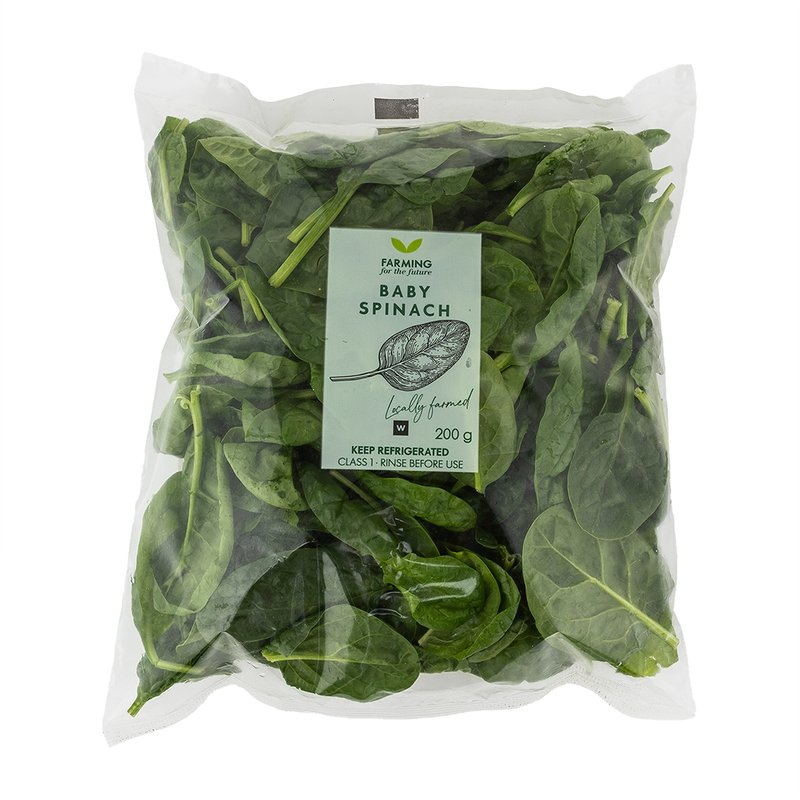
Woolworths Baby Spinach
- Whole food
- Checked
- Grade B
Baby Spinach by Woolworths has 30 kcal, 1 g carbs, 2.9 g protein and 0.4 g fat per serving (100 g).
Woolworths Baby Spinach is a fresh, versatile ingredient featuring young, tender leaves. It's a low-calorie option, with only 23.7 kcal per serving (100 g), making it suitable for athletes aiming to maintain a lean physique. With 2.2 g of fiber per serving, it supports digestive health, which is crucial for nutrient absorption. While not a primary energy source due to its low carb content (1 g per serving), it's rich in micronutrients like potassium (558 mg per serving), aiding in muscle function and fluid balance. Best consumed as part of a balanced meal post-training or as a light pre-session snack, it complements higher-carb foods to support endurance performance.
- Low-calorie, nutrient-rich option
- High in potassium for muscle function
- Supports digestive health with fiber
On the label per serving, 100 g
| Energy | 124 kJ |
|---|---|
| Calories | 30 kcal |
| Carbs | 1.0 g |
| Sugar | 0.7 g |
| Fibre | 2.7 g |
| Protein | 2.9 g |
| Fat | 0.4 g |
| Saturated fat | 0.1 g |
| Cholesterol | 0 mg |
| Sodium | 79 mg |
| Potassium | 558 mg |
The numbers that matter on a training day
For endurance who it suits
While not a direct energy source, Woolworths Baby Spinach is a valuable nutritional component for endurance athletes. Its low calorie, high micronutrient profile supports overall health and recovery. It's best used in conjunction with higher-carb foods to meet energy demands.
Ideal for endurance athletes such as runners, cyclists, and triathletes who prioritize nutrient density without excess calories. It's suitable for those focusing on maintaining a lean body composition while ensuring adequate micronutrient intake. Vegan athletes and those with gluten intolerance will find it particularly beneficial due to its dietary compatibility.
Best suited for light training days or as a recovery meal component. It provides essential nutrients without heavy caloric load, making it ideal for recovery days or easy sessions.
- Low calorie, high nutrient density
- Rich in potassium for electrolyte balance
- Supports digestive health with fiber
- Vegan and gluten-free, broad dietary compatibility
- Low carbohydrate content, not an energy source
- Minimal sodium content for sweat replacement
- Potential contamination risks as per recent recalls
- Potential contamination with toxic plants
- High fiber may cause GI distress if consumed in excess pre-race
Fuelling science in short
No, not practical for during workouts due to low carb content and fiber, which can slow digestion and cause GI distress.
Baby spinach has a negligible impact on blood sugar due to its low carbohydrate content. It won't cause rapid spikes or drops in blood glucose, making it a stable addition to meals.
Contains 63 mg of sodium per serving, which is minimal compared to the 300-600 mg/hr sweat loss in endurance athletes. However, 558 mg of potassium supports muscle function and fluid balance.
- Total carbs
- 1 g
- Hourly capacity
- Not applicable due to low carb content
Race day before, during and after
- BeforeDO NOT USE
- DuringDO NOT USE
- AfterUSE
- Carb loadDO NOT USE
- Every dayUSE
Pre-race and during-race use is unsuitable due to high fiber content, which can slow gastric emptying and cause GI distress. It's beneficial in recovery due to its micronutrient content and can be used in everyday training for its nutritional benefits.
NOT RECOMMENDED for pre-race use because it contains high fiber, which can slow gastric emptying and potentially cause GI distress during high-intensity efforts.
NOT RECOMMENDED during racing because it provides negligible carbohydrates and is high in fiber, which can cause gastrointestinal issues.
USE as part of a recovery meal, paired with protein-rich foods to aid muscle repair and replenish nutrients.
- Combine with quinoa for a balanced meal with carbs and protein.
- Add to smoothies with fruit for a nutrient boost.
- Pair with grilled chicken for a protein-rich recovery meal.
For practitioners the evidence
Evidence grade: C — While spinach is nutrient-rich, its role in endurance contexts is limited by low carb content. Contamination risks further complicate its use.
Baby spinach has a low carbohydrate density, with only 1 g of carbs per 100 g. This makes it unsuitable for carb loading, as it contributes minimally to the 600-840 g/day target for a 70 kg athlete. Its low energy density and high fiber content can lead to gastrointestinal fill-up before reaching necessary carb intake levels. A 100 g serving provides only 1 g of carbs, requiring impractical quantities to meet loading targets.
Baby spinach is low in carbs, so it doesn't significantly impact glucose pathways like SGLT1 or GLUT5. Its fiber content can slow gastric emptying, potentially delaying nutrient absorption. The small intestine absorbs its micronutrients, while unabsorbed fiber may undergo fermentation in the colon, potentially causing gas. Its low energy density means it doesn't rapidly enter the bloodstream, minimizing insulin spikes.
While baby spinach provides essential micronutrients like potassium, aiding muscle function and fluid balance, its negligible carb content means it doesn't significantly contribute to glycogen resynthesis. It lacks protein, thus not supporting muscle protein synthesis directly. As a recovery food, it should be combined with protein and carb-rich foods to meet post-exercise nutritional needs.
High fiber content can cause gastrointestinal distress if consumed in large quantities pre-exercise. Recent contamination reports highlight potential risks of toxic plant material, necessitating thorough washing. Its low sodium content is inadequate for replacing sweat losses in endurance athletes, requiring supplementation from other sources.
- Do not use as a primary carb source for carb loading — insufficient carb density.
- Do not consume in large quantities pre-race if not gut-trained — high fiber may cause GI distress.
- Do not rely on for sodium replacement during long endurance events — inadequate sodium content.
- Potential contamination with toxic plant material poses health risks.
- High fiber content may cause gastrointestinal distress during exercise.
- Low sodium content inadequate for replacing sweat losses in endurance athletes.
- Negligible carbohydrate content fails to support glycogen resynthesis post-exercise.
- Jeukendrup 2010, Sports Medicine — carbohydrate ingestion and endurance performance.
- Burke 2015, Journal of Sports Sciences — dietary strategies for endurance athletes.
- Stellingwerff 2011, International Journal of Sport Nutrition and Exercise Metabolism — carbohydrate periodization and training adaptation.
Questions about Baby Spinach
How many carbs are in Baby Spinach by Woolworths?
1 g of carbs per serving (100 g), with 30 kcal and 2.9 g protein.
Can I eat baby spinach before a race?
It's not recommended due to its high fiber content, which can cause digestive issues during intense activity.
How much baby spinach should I eat?
Incorporate it as part of a balanced meal, focusing on variety and moderation to avoid excessive fiber intake.
Is baby spinach good for recovery?
Yes, when paired with protein and carbs, it aids recovery by providing essential nutrients and antioxidants.
Can I use baby spinach in smoothies?
Yes, it's a great addition to smoothies for a nutrient boost, but balance with other ingredients to ensure sufficient energy intake.
Does baby spinach contain allergens?
Baby spinach itself is free from common allergens, but always check for potential cross-contamination in processing.
Is baby spinach suitable for hot-weather training?
Yes, it provides hydration and nutrients, but ensure adequate sodium intake from other sources to compensate for sweat losses.
Eating this today? Log it in one tap.
Say "Baby Spinach" and it lands in your diary, counted against today's carbs and protein.