How Glyco computes it.
- Every number opens
- The rules the app runs on
The rules the app runs on, in plain words. If a figure in Glyco ever surprises you, the reason is on this page or one tap away from the figure itself.
- 01
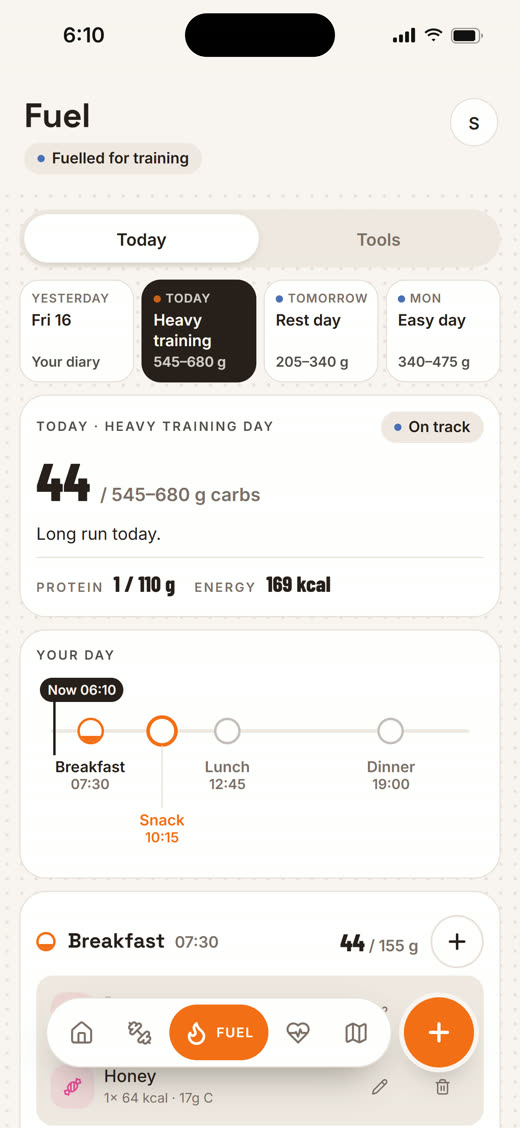
Fuel stores, not a calorie ledger
Glyco models what is in your muscles, your liver and your blood, three separate stores that fill and drain at different rates. A long run empties the muscle store; a night's sleep drains the liver; a gel tops up the blood first. The gauge you see is the average of the three.
The number carries across days. It does not reset at midnight, because your body does not. That is why a low Monday reads "still refilling from Sunday's long run" rather than looking like a fault.
The model reads the last three days of training and food, and looks ahead to tomorrow's session. With no logged food it runs on a population prior and says so: "early read".
- 02
Carbohydrate per hour
Your gut sets the ceiling. One sugar transporter in the gut saturates at about sixty grams an hour; glucose and fructose together let a trained gut take up to ninety. So the race planner starts from how trained your gut is: sixty grams an hour untrained, seventy-five moderately trained, ninety trained.
The plan aims a margin below that ceiling, by how hard the effort is: three quarters of it on an easy day, 85% at a steady effort, 95% at threshold, all of it on race day.
Your own number wins. Type the carbs an hour you know you can take and the plan aims at exactly that, and it still never goes past what your gut and the fuels you carry allow. A number you have measured beats a number we estimated, everywhere in Glyco.
- 03
Fluid and sodium
The planner starts from about 1.2 litres of sweat an hour carrying 800 milligrams of sodium per litre. Once you have set your own sweat rate, or how salty your sweat is, it uses yours instead.
How salty your sweat is can be read off your own kit: standard (no white marks), salty (white streaks, stinging eyes) and crystalline (salt on your skin).
Sodium per hour is your sweat rate multiplied by how salty it is, and the plan shows how much of that your fuels replace.
- 04
Fuel stops
The planner works out how many stops it takes to deliver the carbohydrate target with the products you actually carry, keeps them at least two to three kilometres apart, and places them where the course allows, later on climbs and earlier before them.
- 05
What is estimated and what is measured
Estimated until you tell us otherwise: sweat rate, threshold pace, gut limit, and the fuel stores on your first days. Each field in the app says which it is and what would replace the estimate.
Measured: every session from Strava or your watch, every meal you log, every check-in. The training side calibrates from your history on day one; the fuel side needs a few days of logging before the stores go from a population prior to your own.
- 06
What Glyco does not do
It does not count calories as a target. It does not show a streak or a score in the numbers-free view, which exists for athletes for whom figures are a hazard. It does not hide a number behind an email address: the race planner works in full without an account, and you sign up only to save your plan.
The race planner works in full without an account; you sign up only to save your plan.
Every number opens. In the app too.
Tap any figure in Glyco and it says where it came from, what is estimated, and what would make it yours.